

China Top 10 Electrical Wire Manufacturers for Global Buyers
Choosing an electrical wire manufacturer is not simply a price comparison. Global buyers must examine safety, conductivity, insulation quality, production capacity, and delivery reliability. A polished catalog can hide practical weaknesses.
This guide introduces China’s top 10 electrical wire manufacturers for international purchasing teams. The selection considers factory experience, product range, quality systems, export performance, technical support, and customization ability. It also considers whether each supplier can provide clear test reports, traceable materials, and consistent batch performance. Those details matter when wire is installed inside crowded control cabinets, underground conduits, or high-temperature industrial equipment.
“Good fortune is what happens when opportunity meets with planning,” Thomas Edison once said. His words fit wire sourcing surprisingly well. A buyer needs more than a low quotation. They need planning, verification, and an honest comparison of risks. That means checking copper purity, conductor structure, voltage ratings, flame resistance, bend performance, and applicable international standards. It also means asking difficult questions about lead times and replacement support.
Small details matter.
A reliable electrical wire partner should answer technical questions clearly, not hide behind general promises. Factory visits, sample testing, and independent inspections can strengthen confidence before large orders. Still, no ranking is perfect. Supplier capabilities change, and published information may become outdated. Buyers should confirm current certifications, production capacity, and market requirements directly with each manufacturer.
This overview is designed as a practical starting point. It does not replace engineering review. Used carefully, it can help procurement managers reduce uncertainty and identify manufacturers suited to demanding global projects.
Electrical Wire Manufacturing in China: Industry Overview and Product Scope
China Top 10 Electrical Wire Manufacturers for Global Buyers
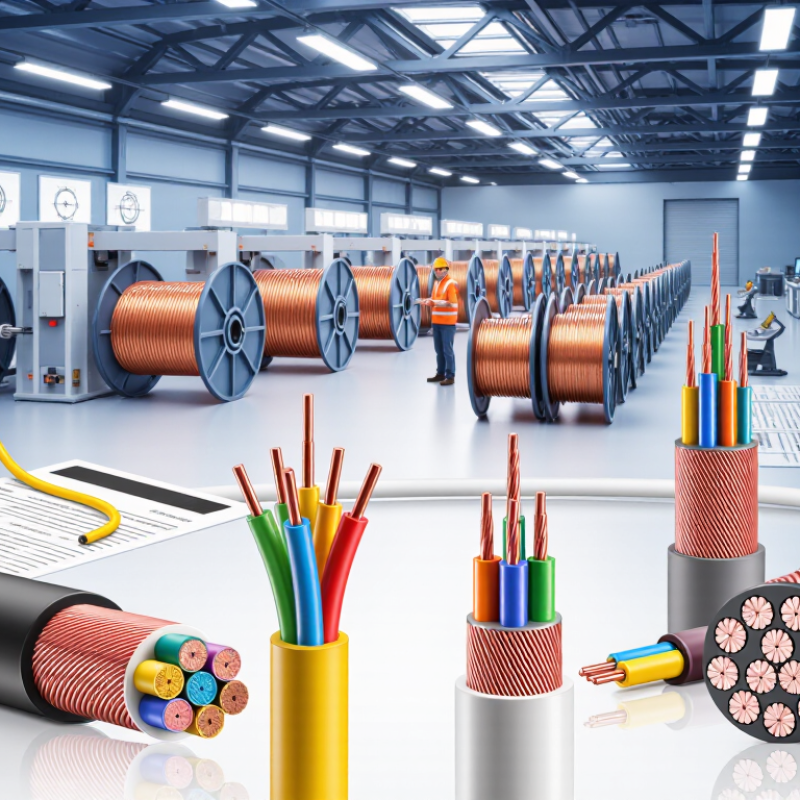
Electrical Wire Manufacturing in China: Industry Overview and Product Scope
China’s electrical wire industry supports construction, power transmission, renewable energy, transport, and industrial automation. A 2024 Mordor Intelligence report valued the global wire and cable market at more than USD 200 billion, with Asia-Pacific remaining the largest regional market. China’s production ecosystem covers copper and aluminium conductors, building wires, flexible cables, control cables, power cables, data cables, and photovoltaic applications.
Manufacturers commonly work with GB/T and IEC requirements, while export projects may require additional testing under UL, EN, or other local standards. Product quality depends on conductor resistance, insulation thickness, voltage performance, flame behavior, and temperature ratings. The International Electrotechnical Commission stresses consistent testing and documentation across cable production. In practice, buyers should request batch records, material certificates, factory inspection reports, and third-party test results.
The weak point is often hidden in small details. A catalogue may show hundreds of products, yet offer limited customization. Copper purity, concentricity, printing accuracy, and packaging can affect installation costs. The China Customs Statistics database also shows strong export activity for insulated wires and cables, but export volume alone does not prove technical reliability. Buyers need samples tested under real operating conditions. Short samples can mislead. A better review checks bending, heat exposure, marking durability, and terminal compatibility. This step takes time, but it can expose weaknesses before large-scale procurement.
| Rank | Representative Product Capability | Typical Product Scope | Conductor Construction | Insulation / Sheath Materials | Typical Voltage Range | Common International Standards | Typical Buyer Applications | Key Export Documentation |
|---|---|---|---|---|---|---|---|---|
| 1 | Building Wire Supplier | Single-core wire Flat cable Flexible building cable | Solid or stranded annealed copper; aluminum conductors are also available for selected building applications. | PVC insulation, commonly classified as PVC type suitable for fixed wiring and general building installations. | Commonly 300/500 V or 450/750 V, depending on product design and applicable standard. | IEC 60227; IEC 60332-1-2; GB/T 5023; ASTM B3 and ASTM B8 for applicable conductor constructions. | Residential wiring, commercial buildings, lighting circuits, distribution panels, and control cabinets. | Product datasheet, routine test report, certificate of conformity, packing list, commercial invoice, and applicable certification documents. |
| 2 | Low-Voltage Power Cable Supplier | Single-core power cable Multicore cable Armored cable | Stranded compacted or non-compacted copper or aluminum conductors; optional concentric protective layers. | XLPE or PVC insulation with PVC, PE, or LSZH outer sheath options. | Commonly 0.6/1 kV for low-voltage power distribution. | IEC 60502-1; IEC 60228; IEC 60332; IEC 60502-related test requirements. | Industrial power distribution, utility projects, renewable-energy facilities, infrastructure, and construction projects. | Type-test or routine-test reports, conductor-resistance data, flame-test results, technical drawings, and cable drum records. |
| 3 | Flexible Cord and Portable Cable Supplier | Flexible cords Extension cables Portable power cables | Finely stranded or extra-flexible annealed copper conductors designed for repeated movement. | PVC, rubber, thermoplastic elastomer, or other flexible compounds selected for mechanical requirements. | Commonly 300/500 V or 450/750 V, depending on construction and market requirements. | IEC 60227; IEC 60245; EN 50525; applicable national electrical safety requirements. | Portable tools, household appliances, temporary power, stage equipment, and light industrial machinery. | Flexing test results, insulation-resistance report, dimensional inspection report, product specification, and packaging details. |
| 4 | Solar and Photovoltaic Cable Supplier | PV1-F cable DC solar cable Pre-terminated cable assemblies | Tinned or bare fine-stranded copper conductor, normally designed for outdoor photovoltaic installations. | Cross-linked halogen-free or low-smoke compounds with resistance to UV radiation, ozone, and weathering. | Commonly 1.0/1.0 kV DC or 1.5/1.5 kV DC, subject to the certified design. | EN 50618; IEC 62930; IEC 60228; IEC 60332-1-2; applicable photovoltaic connector requirements. | Solar modules, rooftop systems, utility-scale photovoltaic plants, combiner boxes, and inverter connections. | UV and weathering test data, flame-performance report, conductor-resistance report, material declaration, and traceability records. |
| 5 | Control and Instrumentation Cable Supplier | Control cable Pair cable Screened cable | Solid or stranded copper conductors arranged in cores, pairs, or groups according to the circuit design. | PVC, PE, XLPE, or LSZH insulation; overall foil, braid, drain-wire, or collective screen options. | Commonly 300/500 V or 450/750 V; instrumentation versions may use lower signal voltages. | IEC 60227; IEC 60228; IEC 60332; IEC 60754 and IEC 61034 for applicable halogen-free designs. | Automation systems, process control, industrial machinery, switchgear, building management, and signal transmission. | Core-identification chart, screening specification, electrical test report, cable construction drawing, and EMC-related technical data. |
| 6 | Data and Communication Cable Supplier | Twisted-pair cable LAN cable Coaxial cable | Solid or stranded copper conductors; shielded and unshielded pair constructions are available. | PE or LSZH insulation and jacket materials are commonly used for communication applications. | Signal-performance category rather than a power-voltage rating; installation voltage must follow the relevant cable standard. | ANSI/TIA-568.2-D; ISO/IEC 11801; IEC 61156; IEC 60332 for applicable flame-performance designs. | Data centers, structured cabling, telecommunications, security systems, offices, and industrial Ethernet networks. | Insertion-loss data, return-loss data, NEXT and FEXT results, impedance report, flame test, and cable-performance certificate. |
| 7 | Fire-Resistant and Flame-Retardant Cable Supplier | Fire-resistant cable Low-smoke cable Halogen-free cable | Copper conductors with mica tape, mineral insulation, or other fire-performance layers where required by the design. | LSZH, mica-tape composite, silicone rubber, or other fire-performance insulation and sheath systems. | Commonly 300/500 V, 450/750 V, or 0.6/1 kV, depending on product type. | IEC 60331; IEC 60332; IEC 60754; IEC 61034; EN 50200 for applicable emergency-circuit cables. | Emergency lighting, fire pumps, alarm systems, transportation facilities, hospitals, and high-rise buildings. | Fire-resistance duration report, smoke-density test, acid-gas test, flame-propagation report, and material compliance declaration. |
| 8 | Rubber-Insulated Cable Supplier | Welding cable Mining cable Heavy-duty flexible cable | Highly flexible stranded copper conductors, with cross-sectional area selected for current and mechanical requirements. | EPDM, EPR, chloroprene rubber, or other elastomeric compounds for flexibility and environmental resistance. | Commonly 300/500 V, 450/750 V, or 0.6/1 kV, depending on application. | IEC 60245; IEC 60228; applicable mining, welding, or industrial cable standards. | Welding equipment, mobile machinery, construction sites, mining equipment, cranes, and outdoor industrial operations. | Flexibility test, abrasion-resistance data, oil-resistance data, low-temperature test, electrical test report, and construction drawing. |
| 9 | Automotive and Battery Cable Supplier | Battery cable Vehicle wire Charging cable | Fine-stranded copper or tinned copper conductors designed for vibration, bending, and compact routing. | PVC, XLPE, cross-linked polyolefin, silicone, or other automotive-grade insulation systems. | Low-voltage vehicle wiring commonly operates at 12 V or 24 V systems; high-voltage vehicle cables use specialized certified designs. | ISO 6722; ISO 19642; LV 112 or equivalent customer specifications; applicable EV charging standards. | Passenger vehicles, commercial vehicles, battery systems, electric vehicles, charging equipment, and mobile machinery. | Temperature-rating data, abrasion test, chemical-resistance test, bending test, conductor-resistance report, and material-compliance documentation. |
| 10 | Specialty and Custom Cable Supplier | High-temperature wire Coaxial cable Multi-standard cable | Copper, tinned copper, silver-plated copper, aluminum, or other specified conductors based on temperature and signal requirements. | PTFE, FEP, silicone, fiberglass braid, PUR, LSZH, or other engineered insulation and jacket materials. | Application-specific; ratings may range from extra-low voltage to 1 kV or higher for specialized designs. | IEC, UL, CSA, MIL-specification, or customer-defined standards, depending on the target market and application. | Aerospace equipment, medical devices, robotics, laboratory equipment, rail transit, marine systems, and customized machinery. | Full technical specification, material certificates, qualification tests, process-control records, sample approval, and lot traceability documents. |
Related Posts
-
What Are the Top Electrical Wire Types for Global Buyers?
-
Top 10 Control Cable Types for Optimal Performance in Industrial Applications
-
Why Choose Electric Cable Wire for Global Buyers?
-
Why Are Electrical Connectors Essential for Reliable Electrical Connections?
-
2025 Top 5 Industrial Electric Wire and Cable Solutions for Every Business Need
-
Maximizing Safety and Efficiency: The Essential Guide to Choosing Electrical Wire Connectors in 2023